
Pin Map Active Layer
Overview
-
When a Pin Map Layer is the Active Layer for a Multi-Layer Widget you will notice very similar features to that of a Filter Widget.
-
You will still see all layers in the Multi-Layer Widget that are turned on, however you will only see Charts and Reports for the Pin Map Layer.
-
You can view the widget in Minimized or Maximized State. Minimized and Maximized State have common interaction and they also both have features that are State specific.
Common Interaction
Record Count
-
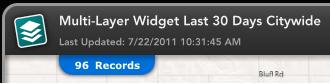
Whether in the Minimized or Maximized State, the record count is visible at the top left of the map window.
-
The record count identifies the number of records that are currently being displayed on the map.
Record Count for Multi-Layer Widget
Panning and Zooming
-
Both Minimized and Maximized States provide panning and zooming capabilities within the map.
-
There are three options to zooming into the map when the widget is in Minimized or Maximized States.
-
To zoom into the map, left click the mouse, hold down the shift key, and drag the mouse to create a zoom window.
-
Another way to zoom into the map is to use the mouse wheel. Click on the map, and push the mouse wheel to zoom in.
-
A third way to zoom into the map is to double click on the map which will zoom the map one zoom level.
-
To zoom out of the map, click on the map, and pull the mouse wheel.
Clustering
-
Clustering is used to improve the display performance of the Dashboard when a large number of features must be displayed.
-
Data points are grouped together according to their location if they are in close proximity to one another.
-
Clusters are identified with a standard symbol which includes the number of data points in each cluster.
-
Clicking on a cluster on the map, zooms the map to a smaller scale where more feature clusters may be displayed.
-
Zooming into the map can be repeated until individual features are revealed.
-
Clustering occurs in both the Minimized State and Maximized State. Clusters may appear different however between the two states.
Filter Widget with Clusters in Minimized State

Stacked Features
-
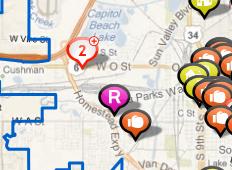
Stacked features are identified by a different icon which includes the number of features at the same geographic location.
-
The number within the icon indicates the number of features found at that location.
-
The feature stack is different from the feature cluster; a cluster is a set of features which have occurred near each other, while stacked features occur at the same location.
Individual Icons
Maximized State
-
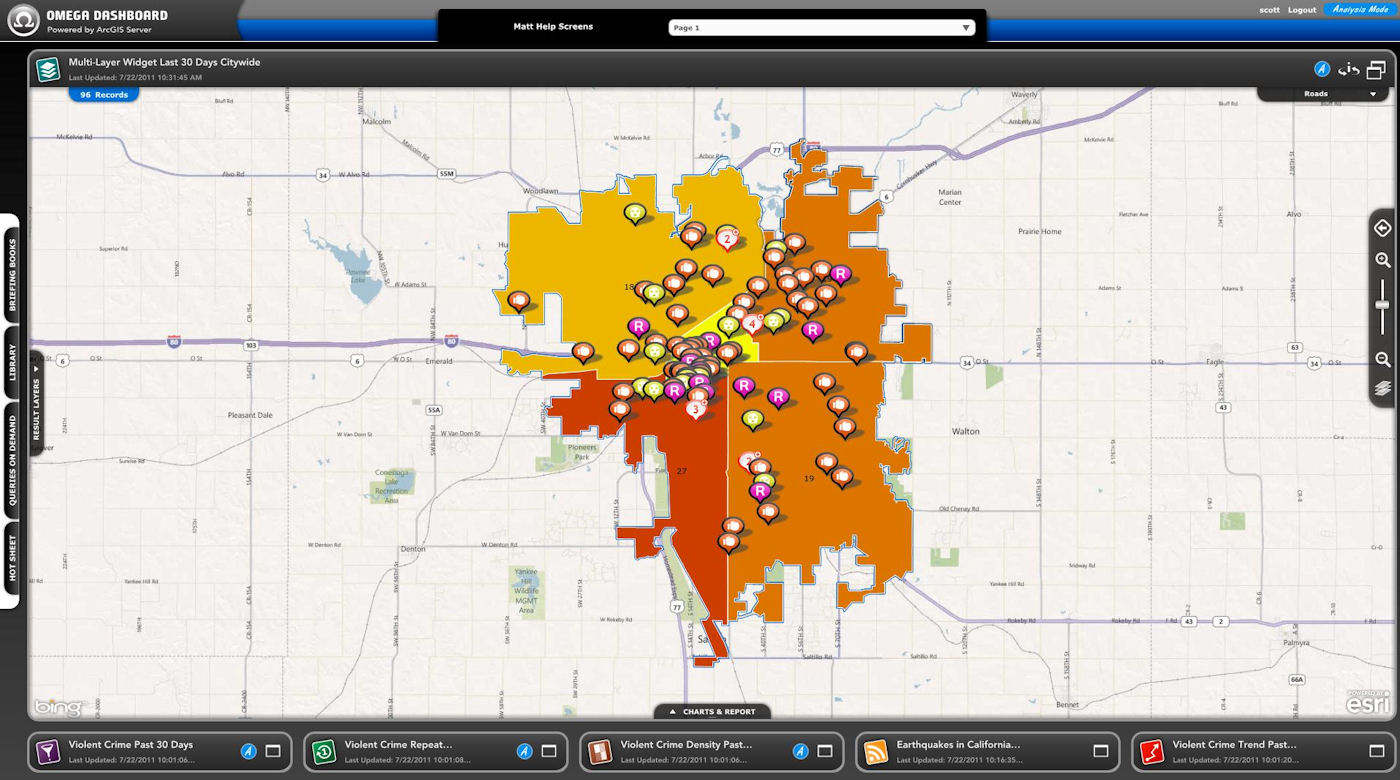
A Filter Widget in Maximized State has a number of features exclusive to the Maximized State.
Multi-Layer Widget in Maximized State
Identify Tool
-
One aspect of the Maximized State which is not available in the Minimized State is the ability to identify.
-
To identify a data point, zoom in on the map until clusters disappear.
-
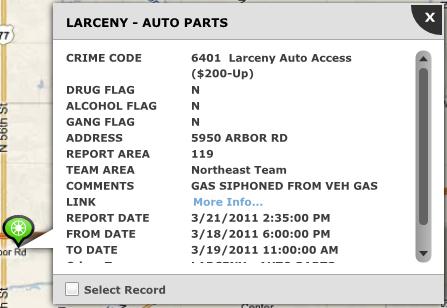
Click on any data point to view the Attribute Table containing detailed information about that incident.
-
If you click on a location that contains more than one data point, you can scroll through the incidents using the arrows on the upper right side of the Attribute Table.
-
You can click the Select Record check box on the bottom left portion of the Attribute Table dialogue box to highlight the selected data point on the map. A blue halo will highlight the data point.
Attribute Table
Results Layers Tab
-
On the left side of the Widget you will see a Results Layers tab.
-
When expanded you can set options for the result layers, turn layers on or off and change the active layer.
-
The eye icon will let you turn layers on or off. This icon will be green if a layer is turned on and when turned off it will be grey.
-
You can then see the layer type and name.
-
On the right side of the line you can see up and down arrows that will let you set the priority of the layers on the map.
-
You can zoom to the layer with the circular x button.
-
The grey circular i icon will let you see information about the layer such as parameters.
-
You can expand the layer to set up options with the arrow all the way to the right.
Pin Map Layer Options
-
-
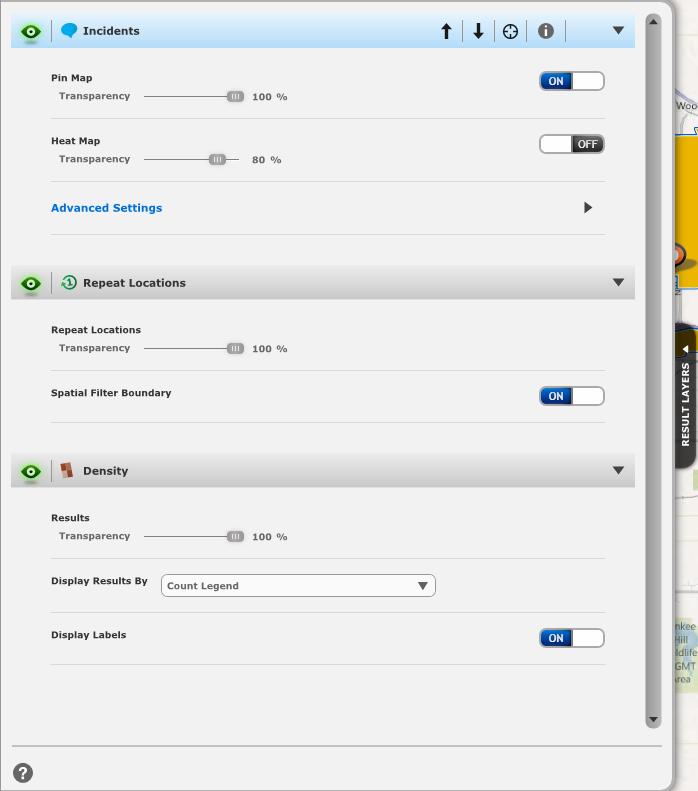
Each type of Result Layer has different options you can use to customize how the results appear on the map.
-
You can see the Pin Map options on the image below as the first expanded Result Layer.
-
The Pin Map section is the first set of options when you expand a Pin Map Result Layer.
-
The Transparency slider will let you adjust the Transparency of the Pin Map.
-
The On/Off button will let you turn the Pin Map on or off.
-
The Heat Map options are below the Pin Map options.
-
You can adjust the transparency of the Heat Map using the slider.
-
You can turn the Heat Map on or off using the On/Off button.
-
The arrow on the right of the Advanced Settings line will let you expand and collapse the Advanced Pin Map Settings.
-
The Highlight Source Area On/Off button will turn off highlighting of the geographic boundary your results are contained in.
-
The Use Legend Type drop down menu will let you change the Legend Type for the results. The options on this menu will depend upon your Dashboard's configuration.
-
The Use Date/Time Group drop down will let you change the Date/Time group. The options on this menu will depend upon your Dashboard's Configuration.
-
Results Layers tab for an Maximized Multi-Layer Widget. Pin Map options are first.
Base Map Options
-
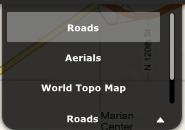
You can change the base map type using the drop down menu in the top right corner of the map.
-
The choices you see will depend upon your Dashboard's configuration.
Base Layer Drop Down
Map Toolbar
-
The toolbar in the central right portion of the map has tools to control the view of the map.
-
Clicking on the arrow in the upper left corner of the map toolbar, opens a full view of the map tools.
Map Toolbar
Overview Map
-
-
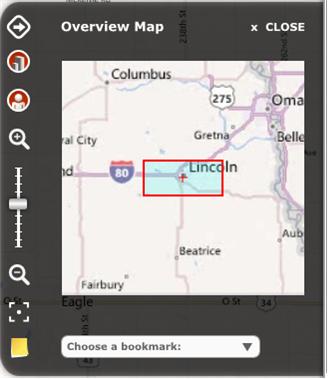
The Overview map gives an overview of the area in which the larger map is currently centered.
-
This tool is helpful to gain perspective on the geographic location of the map window.
-
Click on the highlighted window within the overview map, and pan the window to move the larger map.
-
Zoom Tools
-
-
The Zoom tools move in and out of the main map.
-
Zooming is accomplished using the magnifying glass tools or the zoom level slider.
-
The zoom tools allow individual incidents to be displayed, as the map scale is reduced, more features become visible.
-
The Home Extent tool moves both the Overview map and main map to the original extent of the widget.
-
Bookmarks
-
-
Bookmarks are available from the drop down list below the overview map, and are configured by the Administrators or Designers.
-
Each bookmark represents a map extent which can be accessed quickly by selecting the bookmark name from the list.
-
Related Links:
-
Table of Results
-
Temporal Heat Index Filter

© Copyright 2011 The Omega Group. All Rights Reserved.